








Now Reading: Ford Mustang Earns Two Stars Out Of Five In Euro NCAP Testing
-
01
Ford Mustang Earns Two Stars Out Of Five In Euro NCAP Testing
Ford Mustang Earns Two Stars Out Of Five In Euro NCAP Testing
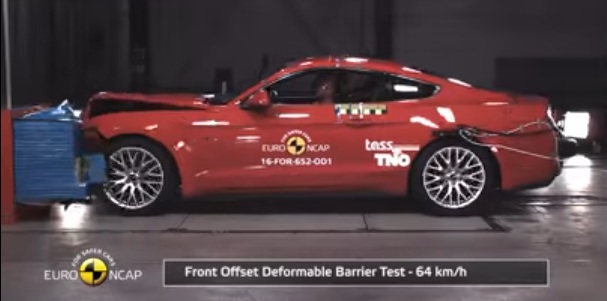
The current-generation Ford Mustang fastback struggled in Europe’s NCAP (New Car Assessment Program) safety testing, achieving just 2 stars out of 5. That should be compared to the United States, where the 2015-2017 Ford Mustang was rated five stars by the National Highway Traffic Safety Administration (NHTSA).
Why the poor rating? As per Euro NCAP Testing, there are “concerns about its crash protection of adult and child occupants and a stressing absence of safety devices frequently provided on the European market.”
Moreover, the European vehicle safety program says that the driver and passenger airbags didn’t pump up enough in crash-testing to “properly restrain the occupants.” Throughout NCAP’s full-width frontal impact testing, a rear-seat occupant even moved under the seatbelt; in side-impact testing, and his head impacted on a piece of interior trim.
Euro NCAP Secretary General Michiel van Ratingen added that the Ford Mustang performed poorly in their testing mostly because the car manufacturer didn’t anticipate the sports coupe to be evaluated, and selected “not to fit safety technology in Europe which is available to its American consumers.” Ford states that the upgraded 2018 model, available starting later 2017, will provide basic Pre-Collision Assist and Lane Keep Assist.
Ideally, the automaker will have exercised the Mustang’s other safety deficiencies, too.
Related Posts

Stay Informed With the Latest & Most Important News
Previous Post
Next Post

Advertisement
-
 01Audi Launches RS3 Competition Limited, Celebrates 50 Years of the Company`s Five-Cylinder Engine Fame
 -
 02Polestar Boss Says It’s Time To Outrun BMW M And Mercedes-AMG
 -
 032026 Corvette ZR1 Production Surges Past Expectations as Output Clears 1,000 Units
 -
 04Spy Shots: 2027 Mitsubishi Pajero Spotted in Testing Ahead of Possible U.S. Return
 -
 052026 Toyota Hilux EV: A Powerful Truck with Silent Torque
 -
 06Spy Photos: VW ID. Polo GTI Goes Electric with 223 HP and 280 Miles of Range
 -
![2027 Mercedes-Benz S-Class Debuts with V8 Engine [Photo Gallery]](https://speedlux.com/wp-content/uploads/2026/01/2027-Mercedes-Benz-S-Class-33-155x125.jpg) 072027 Mercedes-Benz S-Class Debuts with V8 Engine [Photo Gallery]
072027 Mercedes-Benz S-Class Debuts with V8 Engine [Photo Gallery]